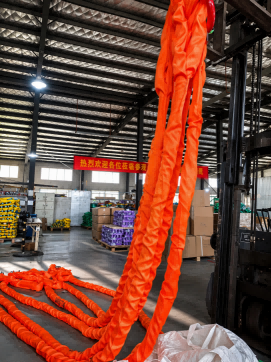
Round slings are widely used in construction, manufacturing, shipping, mining, and other industries where heavy loads need to be lifted safely and efficiently. Compared with some traditional lifting equipment, polyester round slings are lightweight, flexible, and easy to handle. Their soft surface also helps reduce the risk of scratching or damaging the load.
However, not all round slings are suitable for every lifting operation. Choosing the right product requires more than simply checking its working load limit (WLL). Length, material, lifting method, safety factor, and applicable standards should all be considered before placing an order.
In this guide, we will explain the key factors buyers should consider when selecting a polyester round sling.
1. Understand the Working Load Limit (WLL)
The Working Load Limit (WLL) is the maximum load that a sling is designed to lift under specified conditions.
Round slings are available in different load capacities, from light-duty applications to heavy lifting operations involving hundreds of tonnes.
When selecting a round sling, buyers should consider:
-
The actual weight of the load.
-
The number of slings used in the lifting operation.
-
The lifting configuration, such as vertical, basket, or choker hitch.
-
The angle between sling legs in multi-leg lifting.
-
Any additional requirements specified by the lifting plan.
It is important to remember that the rated capacity can change depending on the lifting configuration. A sling should never be selected based on its WLL alone without considering the actual lifting conditions.
2. Choose the Correct Sling Length
Sling length is another important factor that directly affects lifting operations.
An endless round sling is manufactured as a continuous loop, making it suitable for different lifting configurations. Before ordering, buyers should confirm whether the required length refers to the effective working length (EWL) or another measurement specified in their technical requirements.
Incorrect length selection may make lifting difficult or affect the way the load is balanced.
We recommend confirming the following details:
-
Required working length.
-
Load dimensions.
-
Lifting points and their positions.
-
Intended lifting method.
-
Available clearance during lifting.
For customized projects, providing a drawing or photograph of the lifting application can help the manufacturer confirm the correct specifications.
3. Select the Right Material
Most conventional polyester round slings use high-tenacity polyester yarn as their load-bearing core.
Polyester is widely used in lifting applications because it offers several practical advantages:
Good strength-to-weight ratio: Polyester yarn provides high tensile strength without making the sling unnecessarily heavy.
Flexibility: The flexible construction allows the sling to adapt to different load shapes and lifting points.
Low moisture absorption: Polyester absorbs relatively little moisture, which helps maintain its practical performance in normal working environments.
Load protection: The soft outer sleeve helps protect both the internal load-bearing yarns and the surface of the lifted object.
For applications requiring special performance, buyers should discuss the operating environment and material requirements with the manufacturer before ordering.
4. Check the Applicable Standard and Safety Factor
For European-market lifting applications, EN 1492-2 is an important standard covering roundslings made of man-made fibres.
When purchasing round slings, buyers should confirm:
-
Whether the product complies with the required standard.
-
The specified safety factor.
-
Whether the manufacturer can provide relevant test documentation.
-
Whether the product label contains the required identification and load information.
A safety factor of 7:1 is commonly specified for polyester round slings manufactured to EN 1492-2 requirements.
However, buyers should always check the applicable standard and project specifications rather than assuming that all products have identical requirements.
5. Pay Attention to the Outer Sleeve and Stitching
The outer sleeve is not the primary load-bearing component, but it plays an important protective role.
It helps protect the internal polyester yarns from abrasion, dirt, and everyday handling damage.
When evaluating a round sling, pay attention to:
-
Sleeve material and thickness.
-
Consistency of the sleeve width.
-
Stitching quality.
-
Seam condition.
-
Whether the sleeve provides adequate protection for the intended application.
A poorly manufactured sleeve may wear out quickly and expose the internal yarns to damage.
6. Why Manufacturing Quality Matters
Two round slings with the same WLL and length may have different manufacturing quality.
The quality of the raw materials, winding process, sleeve production, stitching, and final inspection all influence the consistency of the finished product.
A reliable manufacturer should have a controlled production process, including:
-
Inspection of incoming raw materials.
-
Control of load-bearing yarn specifications.
-
Monitoring during production.
-
Finished product inspection.
-
Breaking strength testing according to applicable requirements.
-
Product identification and traceability.
These procedures help ensure that products meet their specified technical requirements.
7. What Information Should You Provide When Requesting a Quote?
To receive an accurate quotation, buyers should provide as much technical information as possible.
| Specification | Example |
|---|---|
| Product type | Endless Round Sling |
| WLL | 5 Ton |
| Length | 3 Meters EWL |
| Material | High-tenacity polyester |
| Safety factor | 7:1 |
| Standard | EN 1492-2 |
| Quantity | 100 PCS |
| Special requirements | Customized label or packaging |
If you are unsure about the specifications, simply share your lifting requirements with the manufacturer. An experienced supplier can help you identify the appropriate product.
8. Work with an Experienced Round Sling Manufacturer
Choosing a round sling is not just about finding the lowest price. Consistent product quality, reliable testing, accurate specifications, and stable production capacity are equally important.
NANJING D.L.T SLING CO., LTD is a professional manufacturer of polyester lifting slings and load-securing products in China. With decades of industry experience, we supply endless round slings in a wide range of capacities and lengths for customers in different markets.
Our manufacturing capabilities cover both standard products and customized lifting solutions. We pay attention to raw material selection, production control, finished product inspection, and product traceability.
If you are looking for a reliable round sling supplier, contact our team with your required WLL, length, quantity, and applicable standard.